Open bite: when the front teeth do not meet
Types of open bite, the role of habits, the tongue and breathing, treatment options in children and adults and what the scientific evidence says.

AuthorDr. Fidan AliyevaOrthodontist, Pitts Masters graduate
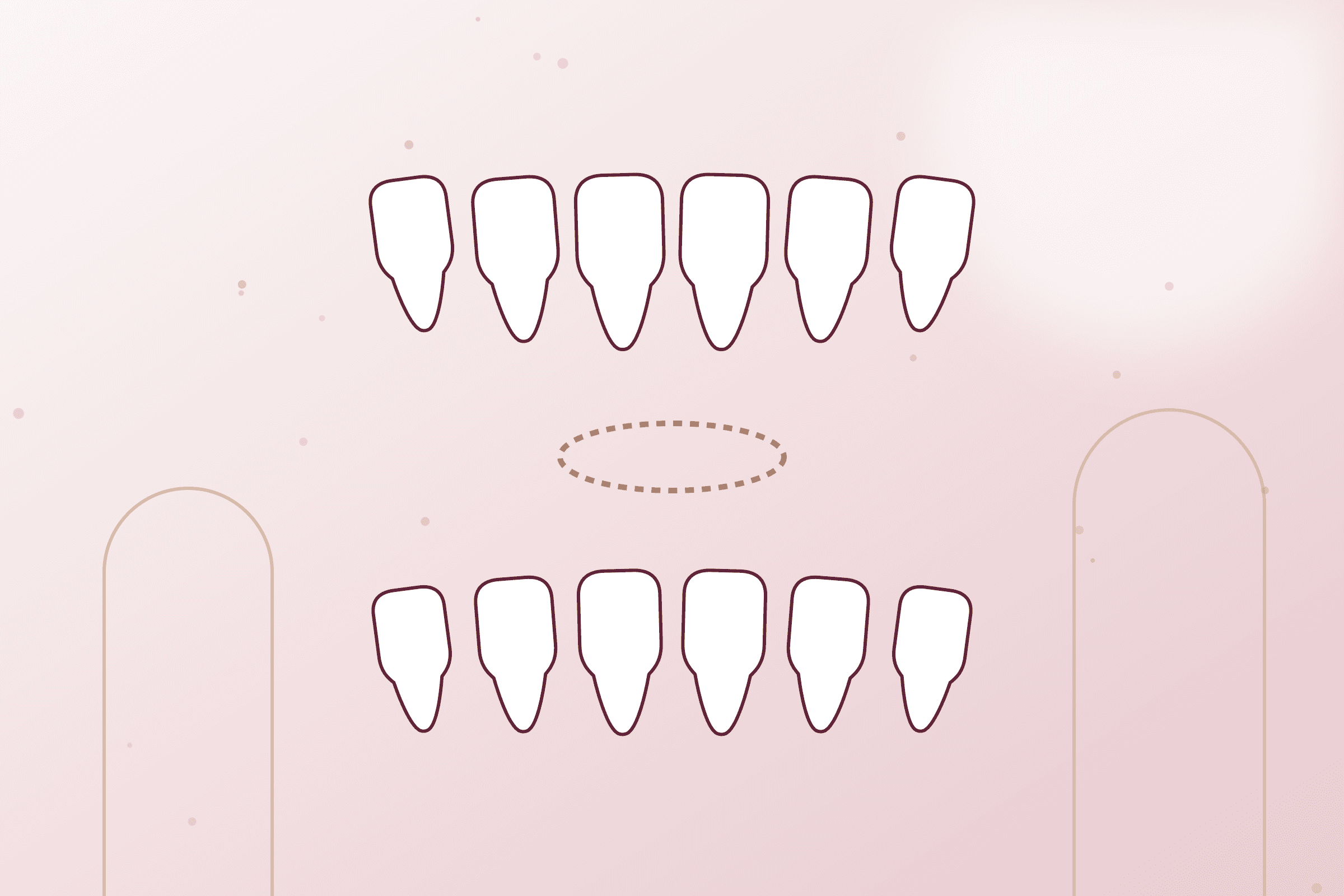
Short answer: an open bite means the front teeth do not meet when the teeth are closed and a gap remains between them. In children the most common causes are long-lasting thumb or dummy sucking, tongue thrust and mouth breathing. If the habit is stopped early, an open bite sometimes improves on its own. In more complex, skeletal cases orthodontic treatment is needed, sometimes with mini-screws and rarely with jaw surgery.
With an open bite a person cannot bite a sandwich or fruit with the front teeth, and some sounds, especially "s" and "z", come out with a whistle between the teeth. Sometimes this is only an aesthetic concern, sometimes it affects chewing and speech. In this article I explain the causes and treatment options.
Types
| Type | Cause | Outlook |
|---|---|---|
| Dental | A habit or the tongue has prevented the front teeth from erupting | Often good once the habit stops |
| Skeletal | The lower face is long, the jaws have grown too much vertically | More complex, prone to relapse |
| Mixed | Both factors together | Assessed individually |
Causes
- Long-term sucking of a thumb, dummy or other objects. See: thumb sucking and teeth
- Pushing the tongue between the front teeth when swallowing
- Habitual mouth breathing and a low tongue position. See: mouth breathing and the bite
- Heredity and a vertical facial growth pattern
- Rarely, diseases of the jaw joint
What we do in children
In children the first step is to remove the cause. A meta-analysis shows that a long-lasting sucking habit is strongly associated with open bite. Once the habit stops, especially at an early age, the front teeth often come closer together again. In some cases we use a special appliance to help stop the habit, and for tongue thrust, exercises that teach the correct tongue position.
- Stopping the habit: conversation, motivation and, if needed, a reminder appliance
- Exercises for tongue position, together with a speech therapist if needed
- Investigating the cause of mouth breathing with an ENT doctor
- Widening a narrow upper jaw. See: palatal expansion
- A short first phase of treatment if needed
In teenagers and adults
In adults treating an open bite is more complex because growth cannot be used. There are two main approaches: lengthening the front teeth slightly, or moving the back teeth upwards into the bone. In the second approach mini-screws are very helpful: when the back teeth are intruded, the lower jaw rotates upwards and the front teeth come closer together. In severe skeletal cases jaw surgery is discussed.
Risk of relapse
Open bite is one of the orthodontic problems most prone to relapse, especially if tongue thrust or the habit continues. That is why I plan retention specially after treatment and we keep an eye on the habits that caused it. See: why retention matters.
What parents should watch for
- Is there a gap between the front teeth when the child bites together
- Does thumb or dummy sucking continue after age 3
- Is the tongue visible between the teeth when speaking
- Does the mouth stay open during sleep
What I look at in diagnosis
- The size of the open bite and which teeth it involves
- The tongue position when swallowing and speaking
- Whether the lips close comfortably at rest
- Nasal breathing
- Vertical facial proportions, with a cephalometric X-ray
- Whether there are habits and how long they have lasted
This analysis shows whether the open bite is dental or skeletal. The outlook and the treatment path differ accordingly.
Tongue thrust and the speech therapist
Pushing the tongue between the front teeth when swallowing can be both a cause and a consequence of an open bite. When the teeth do not meet, the tongue fills the gap and the habit becomes stronger. That is why exercises that teach the correct tongue position are often part of the plan during treatment. When needed we work together with a speech therapist or a specialist in myofunctional therapy. The exercises should be short but regular.
What the science says
- Cochrane review (2014): evidence on orthodontic and orthopaedic treatment of open bite in children is weak; there are not enough high-quality studies to say which method is most effective.
- Meta-analysis (2016): a long-lasting sucking habit considerably increases the risk of open bite.
This means there is no single recipe for open bite. Finding and removing the cause is the main part of treatment.
With an open bite you need to treat not only the teeth but also the cause that keeps them apart.
About treatment for children: orthodontics for children. For adults: braces treatment. To have a check, book a visit.
Frequently asked questions
Can an open bite go away on its own?
In young children, if the habit is stopped early, sometimes yes. In adults and in skeletal cases it does not go away on its own.
Does an open bite affect speech?
It can affect the pronunciation of some sounds. When needed we work together with a speech therapist.
Can an open bite be corrected with aligners?
In some mild cases yes. But the decision depends on the cause and the type of open bite.
When is surgery needed?
In adults with a severe skeletal open bite, when orthodontic treatment alone will not give a stable and aesthetic result.
Does an open bite occur only in children?
No, it is also seen in adults. Treatment in adults can be more complex, but mini-screws help achieve a good result without surgery in many cases.
Related service
Scientific sources
The information in this article is based on the following peer-reviewed scientific articles and systematic reviews.
- Lentini-Oliveira, D. A., Carvalho, F. R., Rodrigues, C. G., Ye, Q., Prado, L. B., Prado, G. F., & Hu, R. (2014). Orthodontic and orthopaedic treatment for anterior open bite in children. Cochrane Database of Systematic Reviews, 2014(9), CD005515. [PMID: 25247473] | [DOI: 10.1002/14651858.CD005515.pub3]
- Doğramacı, E. J., & Rossi-Fedele, G. (2016). Establishing the association between nonnutritive sucking behavior and malocclusions: A systematic review and meta-analysis. Journal of the American Dental Association, 147(12), 926-934.e6. [PMID: 27692622] | [DOI: 10.1016/j.adaj.2016.08.018]