What is a mini-screw and why is it needed?
What stable anchorage means, when mini-screws are used, what science says about them and how placement and care go.

AuthorDr. Fidan AliyevaOrthodontist, Pitts Masters graduate
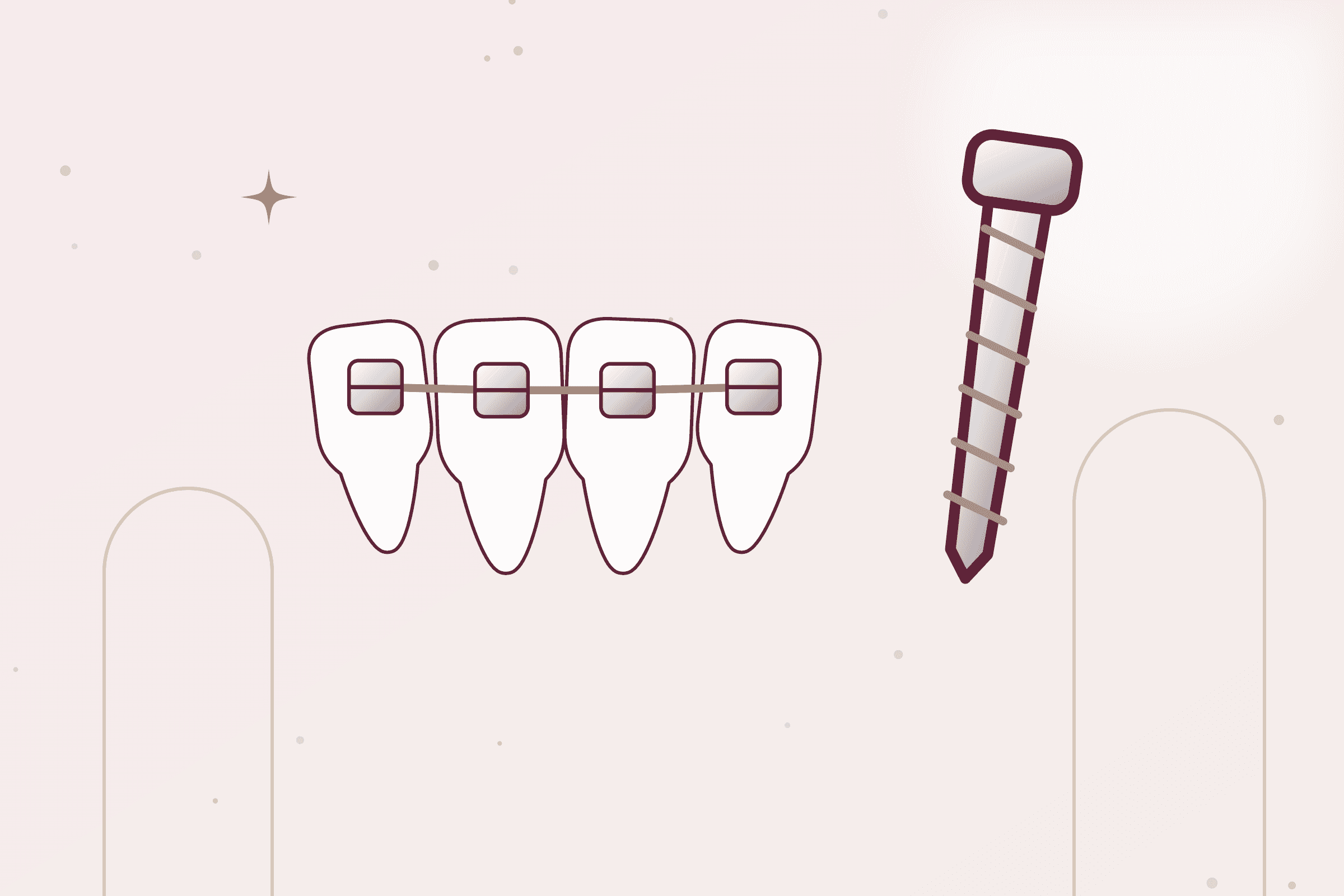
Short answer: a mini-screw (TAD, temporary anchorage device) is a small titanium screw placed temporarily in the jawbone. It acts as an anchor that does not move, so that teeth can be moved. It is placed in a few minutes under local anaesthesia and removed easily when the relevant stage of treatment is over. Meta-analyses show that mini-screws considerably reduce anchorage loss compared with conventional anchorage methods.
When patients hear the word "mini-screw" at a consultation, they often get worried: "A screw in the bone? Like an implant?" In fact it is one of the most useful and simple tools in orthodontics and has nothing to do with an implant. In this article I explain what a mini-screw is, why it is needed, how it is placed and how to look after it.
What anchorage is and why it causes problems
A simple law of physics also works in orthodontics: every action has an equal and opposite reaction. To pull one tooth, you need an anchor somewhere else. Usually this anchor is the neighbouring or back teeth. But they too can move unintentionally under the force. Orthodontists call this "anchorage loss". For example, when the front teeth are pulled back, the back teeth come forward and part of the space created is lost.
A mini-screw, however, stays fixed in the bone and does not move under the force. This makes it possible to move only the teeth that need to move.
How a mini-screw differs from an implant
| Mini-screw | Dental implant | |
|---|---|---|
| Purpose | Temporary anchorage | Permanent replacement of a lost tooth |
| Size | Very small, a few millimetres | Larger |
| Bond with bone | Does not fully fuse, easy to remove | Fully fuses with bone |
| Placement | Local anaesthesia, a few minutes | Surgical procedure |
| Duration | Months, then removed | For life |
What it is used for
- Preventing the back teeth from coming forward when the front teeth are pulled back
- Moving the front teeth upwards in a gummy smile. More: gummy smile
- Creating space without extractions by moving teeth backwards
- Correcting over-erupted or tipped back teeth
- Opening or closing space for a missing tooth
- Correcting the midline and asymmetries
A good orthodontic result is rarely built with a single movement. Mini-screws make it possible to precisely control movements that are difficult to achieve with braces or aligners alone. It is often these details that determine how natural and harmonious the smile will look.
How placement goes
- I choose the site with an X-ray and examination: between the roots or in the palate
- Local anaesthesia is given
- The screw is placed in a few minutes, usually without an incision
- On the same day or a little later an elastic or spring is attached to the screw
- When the relevant stage is over, the screw is removed without or with minimal anaesthesia
There may be mild tenderness for the first few days. Often not even a painkiller is needed. The gum around the screw heals quickly.
Care and risks
- Clean around the screw every day with a soft brush
- Do not wiggle the screw with your tongue or fingers
- If the screw loosens or there is pain and swelling around it, message me
- Sometimes a screw loosens on its own: this is not dangerous and, if needed, it is placed elsewhere
When a mini-screw is not needed
Not every treatment needs a mini-screw. If the tooth movements are simple and anchorage loss will not cause a problem, a good result can be achieved without one. I suggest a mini-screw only when without it the result would be weaker, the treatment longer or the alternative more invasive. I explain this openly at the consultation and we decide together.
Alternatives
| Method | Advantage | Limitation |
|---|---|---|
| Mini-screw | Stable anchorage, does not depend on patient cooperation | Needs a small procedure |
| Elastics | Simple | Must be worn for many hours a day |
| Extraoral appliances | Effective in some cases | Visible, need cooperation |
| Extraction | Creates space | Irreversible, may affect the profile |
What the science says
- Meta-analysis (2011): mini-screws are clinically effective and reduce anchorage loss compared with conventional methods.
- Systematic review and meta-analysis (2017): during en-masse retraction of the front teeth, mini-screws lead to less anchorage loss than conventional anchorage.
- Systematic review (2021): intrusion of the front teeth with mini-screws effectively reduces a gummy smile without surgery.
A mini-screw is not a big intervention. It is a small detail that sometimes changes the whole result.
More about mini-screws is on the service page. Their role in non-extraction treatment is explained on the non-extraction treatment page.
Frequently asked questions
Is placing a mini-screw painful?
It is done under local anaesthesia and most patients feel only pressure. There may be mild tenderness in the first days.
How long does a mini-screw stay in the mouth?
For as long as the relevant stage of treatment, usually a few months. It is removed when the stage is over.
Does it leave a mark after removal?
No. The gum and bone usually heal within a few days.
Are mini-screws used with aligners too?
Yes. They are used as additional anchorage for some movements that are difficult with aligners.
Related service
Scientific sources
The information in this article is based on the following peer-reviewed scientific articles and systematic reviews.
- Papadopoulos, M. A., Papageorgiou, S. N., & Zogakis, I. P. (2011). Clinical effectiveness of orthodontic miniscrew implants: a meta-analysis. Journal of Dental Research, 90(8), 969-976. [PMID: 21593250] | [DOI: 10.1177/0022034511409236]
- Antoszewska-Smith, J., Sarul, M., Łyczek, J., Konopka, T., & Kawala, B. (2017). Effectiveness of orthodontic miniscrew implants in anchorage reinforcement during en-masse retraction: A systematic review and meta-analysis. American Journal of Orthodontics and Dentofacial Orthopedics, 151(3), 440-455. [PMID: 28257728] | [DOI: 10.1016/j.ajodo.2016.08.029]
- Alshammery, D., Alqhtani, N., Alajmi, A., Dagriri, L., Alrukban, N., Alshahrani, R., & Alghamdi, S. (2021). Non-surgical correction of gummy smile using temporary skeletal mini-screw anchorage devices: A systematic review. Journal of Clinical and Experimental Dentistry, 13(7), e717-e723. [PMID: 34306536] | [DOI: 10.4317/jced.58242]