Orthodontics and root resorption: how worried should you be
What root shortening is, how common it is, what increases the risk, the role of gentle forces and how we monitor it during treatment.

AuthorDr. Fidan AliyevaOrthodontist, Pitts Masters graduate
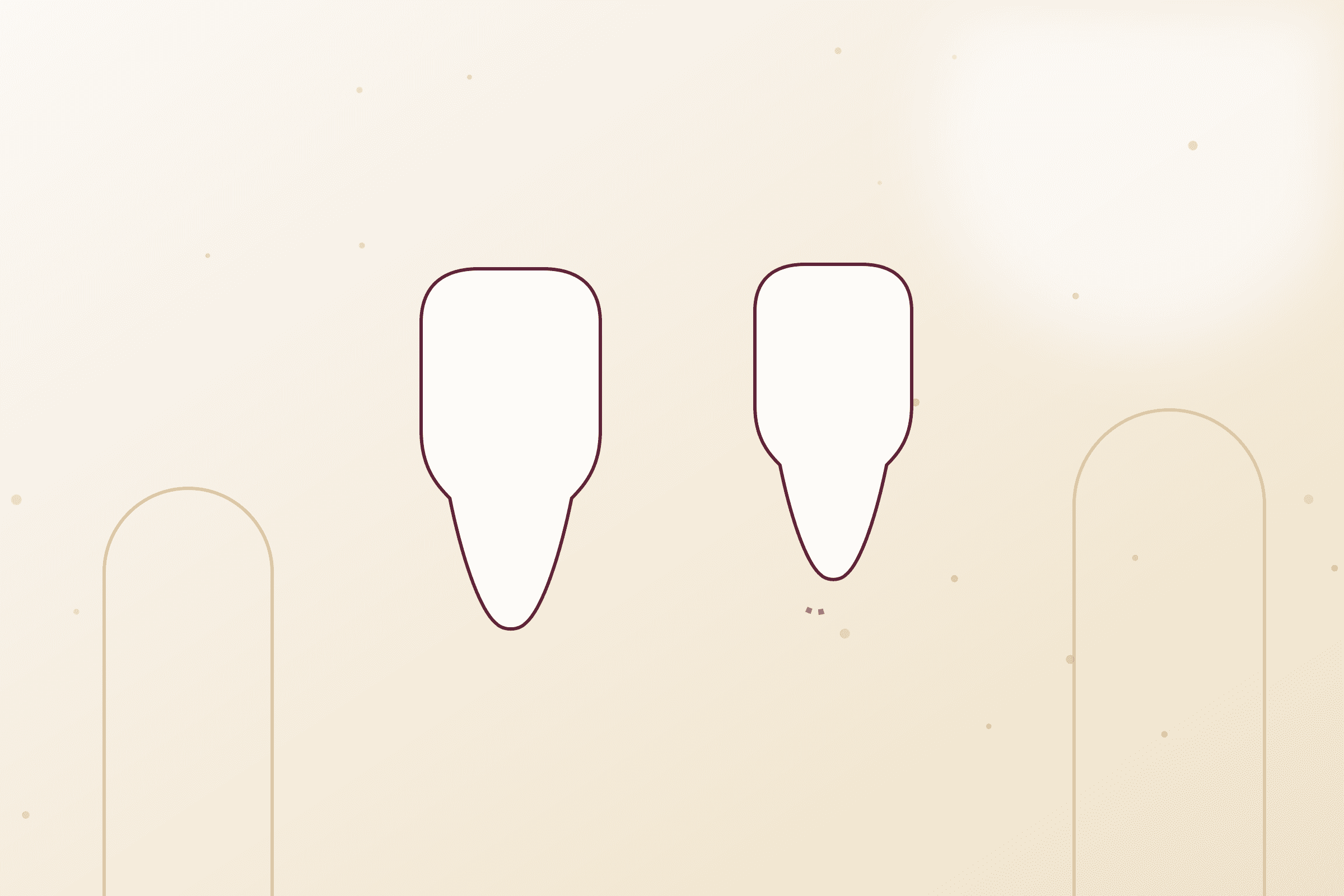
Short answer: root resorption is a slight shortening of the tip of the tooth root during orthodontic treatment. Mild resorption is common and usually does not affect the function or lifespan of the tooth. Severe resorption is rare. According to a systematic review, heavy forces increase the risk, while gentle forces and, when needed, a short pause in treatment may reduce it. In patients at risk we monitor with X-rays during treatment.
This topic is sometimes presented frighteningly on the internet: "braces dissolve the roots". The truth is calmer, but it does need attention. In this article I explain what root resorption is, who is at higher risk and how I keep it to a minimum.
What happens
When a tooth moves, the bone around it is resorbed on one side and rebuilt on the other. This is a natural process. Sometimes this reaction also affects the root itself and a small part of the root tip is resorbed. Most often this is measured in fractions of a millimetre and causes no symptoms.
Degrees
| Degree | What it means | How common |
|---|---|---|
| Mild | The root tip becomes slightly rounded | Very common |
| Moderate | A small part of the root shortens | Less common |
| Severe | A significant part of the root shortens | Rare |
What increases the risk
- Heavy forces
- Long treatment and large movements, especially of the front teeth
- Previous trauma to the tooth
- Root shape features, for example short or thin roots
- Resorption in the family or in previous treatment
- Individual susceptibility, greater in some people
How I reduce the risk
- I work with gentle, continuous forces
- I build a precise plan to avoid unnecessary back-and-forth movements
- Before treatment I look at the shape and length of the roots on an X-ray
- In patients at risk I order a check X-ray after 6-12 months
- If resorption is found, we reduce the forces or give treatment a short pause
This is where the advantage of the Pitts approach shows: when the goal is known in advance, the teeth do not travel unnecessarily. More: what is the Pitts philosophy. About the bracket system and gentle forces: types of braces.
Speed-up methods
Applying strong force to "speed up" treatment may lead not to faster tooth movement but to a higher risk of root resorption. I wrote separately about methods for speeding up treatment: can orthodontic treatment be sped up.
If there is resorption, will the tooth be lost
Mild and moderate resorption usually do not affect the long-term health of the tooth. After active treatment ends, the process as a rule stops. In the case of severe resorption we change the treatment plan, sometimes finishing with a more limited goal. In any case I give the patient open information about it.
Myths and facts
| Belief | Fact |
|---|---|
| Braces dissolve the roots completely | Most often it is mild and does not affect function |
| Root resorption is the same in everyone | Individual susceptibility plays a big role |
| Aligners completely prevent resorption | Resorption can occur with aligners too |
| Resorption continues after treatment | After active treatment ends the process usually stops |
What the patient can do
- If your teeth have been knocked before, be sure to tell me
- If anyone in the family had root shortening after orthodontic treatment, tell me
- Bring old X-rays to the consultation
- Do not delay a check X-ray when it is ordered
- Wear elastics and aligners as instructed: irregular wear moves the teeth back and forth
What I look at on the X-ray
Before treatment I assess the length and shape of the roots and the bone around them on a panoramic X-ray. Short, thin, curved or pointed roots may be more sensitive. When I see such features, I build the plan more cautiously, soften the forces and try to keep the amount of movement to a minimum. A check X-ray taken midway through treatment is compared with the first one. If a change is visible, we discuss it openly with the patient and adapt the mechanics.
What the science says
- Systematic review (2010): orthodontic treatment increases the incidence and severity of root resorption. Heavy forces particularly increase the risk. Light forces and a short pause in treatment when resorption is detected may be beneficial.
Teeth move not with force but with the right force.
To talk about your risks, book a consultation. About treatment: braces treatment.
Frequently asked questions
Does root resorption hurt?
Usually not. It can only be seen on an X-ray.
Is the risk of resorption lower with aligners?
Root resorption can also occur with aligners. The risk depends mainly on the forces, the amount of movement and individual susceptibility.
How often are X-rays taken?
Not the same for everyone. In patients at risk I recommend a check X-ray midway through treatment.
I had resorption in previous treatment. Can I have treatment again?
Often yes, but with an especially cautious plan and gentle forces. Bring your old X-rays to the consultation.
Is the risk of root resorption lower in children?
In children the roots may still be forming. Early and short phases of treatment usually do not pose a big risk, but the decision is always individual.
If there has been resorption, do I need to wear a retainer?
Yes, retention matters in every case. A fixed retainer can be especially useful for teeth with shortened roots.
Related service
Scientific sources
The information in this article is based on the following peer-reviewed scientific articles and systematic reviews.
- Weltman, B., Vig, K. W., Fields, H. W., Shanker, S., & Kaizar, E. E. (2010). Root resorption associated with orthodontic tooth movement: a systematic review. American Journal of Orthodontics and Dentofacial Orthopedics, 137(4), 462-476. [PMID: 20362905] | [DOI: 10.1016/j.ajodo.2009.06.021]