Can orthodontic treatment be sped up?
What two Cochrane reviews say about vibration, lasers, corticotomy and other "fast orthodontics" methods, and what really shortens treatment.

AuthorDr. Fidan AliyevaOrthodontist, Pitts Masters graduate

Short answer: methods claimed to speed up treatment, such as vibration devices, low-level laser and some surgical procedures, have been studied in Cochrane reviews. The evidence that non-surgical methods shorten treatment in a clinically meaningful way is weak. Surgical methods may speed up tooth movement somewhat in the short term, but the certainty of evidence is low. What really shortens treatment is a precise plan, regular visits and good cooperation.
I hear the question "Can the braces come off sooner?" a lot. It is a natural wish. And the market offers many devices and procedures in answer to it. In this article I explain their scientific basis openly so that you can make an informed decision.
Why teeth move slowly
A tooth sits in bone. For it to move, the bone has to be resorbed on one side and rebuilt on the other. This is a biological process and its speed is limited. Stronger force does not move the tooth faster; on the contrary, it may slow the process and increase the risk of root resorption. See: root resorption.
An overview of methods
| Method | How it works | What the evidence says |
|---|---|---|
| Vibration devices | Gentle vibration is applied to the teeth for a few minutes a day | Weak evidence of a clinically meaningful reduction in treatment time |
| Low-level laser | Light energy is applied to the tissues | A small effect in some studies, low certainty of evidence |
| Corticotomy and similar surgical methods | Small cuts are made in the bone and bone turnover speeds up | May speed things up in the short term, low certainty of evidence |
| Medicines and injections | Affect bone turnover | Not enough evidence for clinical use |
About surgical methods
Surgical methods are an additional intervention: they require anaesthesia, a healing period, discomfort and cost. According to a Cochrane review their effect is short-lived and the long-term benefit is unclear. That is why I do not recommend them routinely. In some special cases, for example treatment planned together with jaw surgery, they may be discussed.
What really shortens treatment
- A precise plan: the teeth do not travel unnecessary back-and-forth paths. See: the Pitts philosophy
- Accurate bracket placement: less need to rebond later
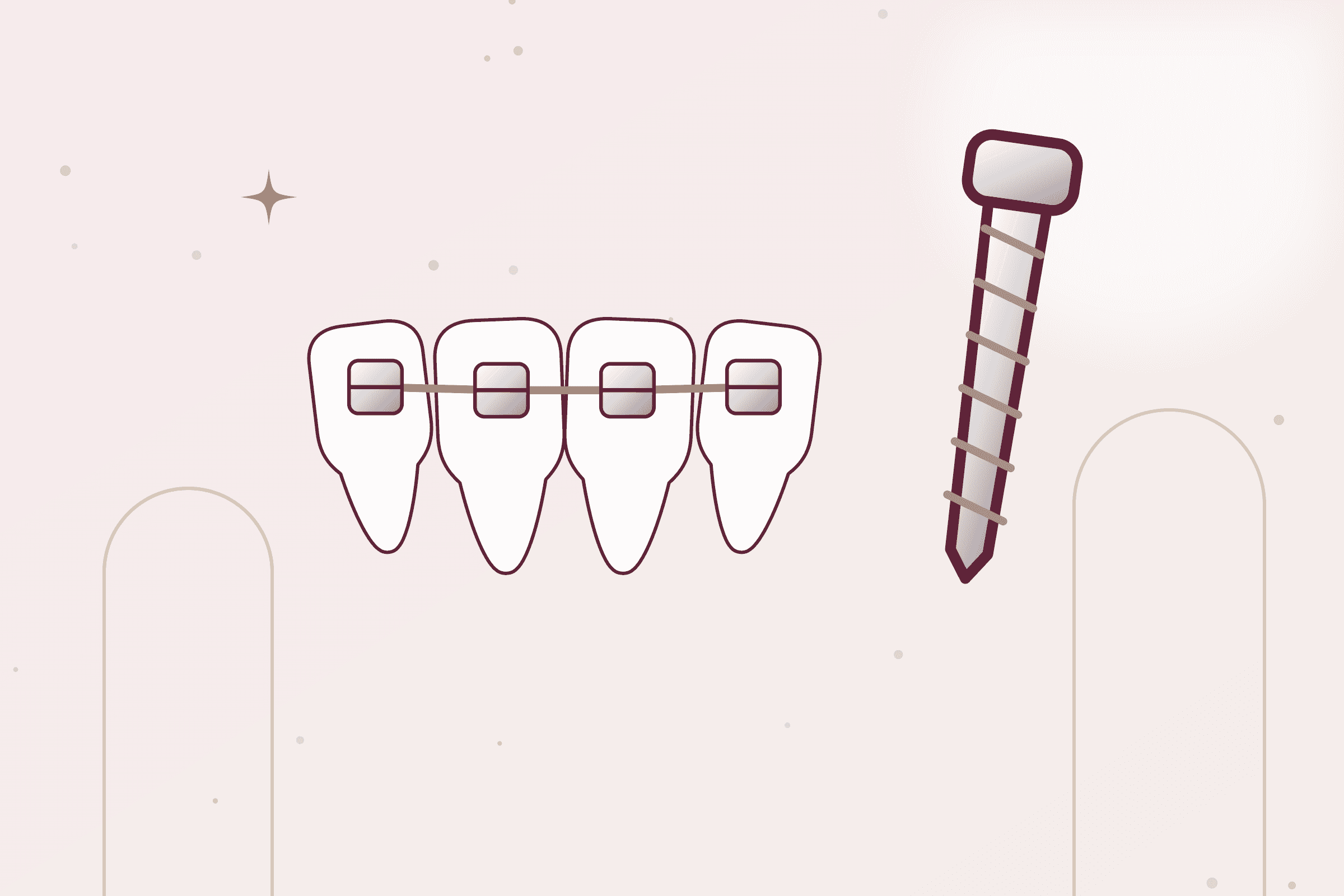
- Mini-screws when needed: direct and precise control of movement. See: what is a mini-screw
- Regular visits: every adjustment is done on time
- Wearing elastics and aligners as recommended
- Avoiding broken brackets: steering clear of hard and sticky foods
- Good hygiene: inflamed gums make movement harder
In one patient living abroad we corrected crowding and the bite in only 6 adjustments. No extra device made this possible, but well planned mechanics. This is not the same for everyone, but it shows how much the plan matters.
What is the average duration
According to a systematic review, treatment with braces takes about 20 months on average. I explained separately what this duration depends on: how long does orthodontic treatment take.
Myths and facts
| Belief | Fact |
|---|---|
| Strong force moves teeth faster | The biological process is limited; strong force increases the risk of root resorption |
| Vibration halves treatment time | Evidence of a clinically meaningful reduction is weak |
| The type of bracket determines speed | Self-ligating brackets have not been shown to have a clear advantage |
| More frequent visits mean a faster result | Teeth need time for biological adaptation |
The methods patients ask about most
At consultations people most often ask about vibration devices and "fast braces". My answer is the same in both cases: these tools have not been shown to be harmful, but there is also no strong evidence that they shorten treatment in a clinically meaningful way. If a patient still wants to use them, we discuss it together, but we keep the main focus on the plan and cooperation, because these affect duration the most.
What the science says
- Cochrane review (2023): the certainty of evidence that non-surgical methods such as vibration and low-level laser shorten treatment is low or very low.
- Cochrane review (2015): surgical adjunctive procedures may speed up tooth movement in the short term, but evidence is limited and of low certainty.
- Systematic review (2016): the average duration of treatment with braces is about 20 months.
The fastest path is the straightest one. And the plan determines it.
If you want to know the approximate duration for your case, book a visit. About treatment: braces treatment.
Frequently asked questions
Is a vibration device harmful?
There is no information that it is harmful, but there is also no strong evidence that it shortens treatment significantly.
If adjustments are done more often, will treatment be shorter?
Not necessarily. The effect of each adjustment lasts for a while, and the teeth need time to adapt biologically.
Can I change aligners faster?
Only with the orthodontist’s permission. Changing aligners faster on your own can make the teeth fall behind the plan.
What can I do to shorten treatment?
Come to visits on time, wear elastics and aligners as instructed, protect the brackets and look after hygiene.
Do mini-screws speed up treatment?
Mini-screws do not make teeth move faster, but they make movement more direct and precise. In some cases this can cut out unnecessary stages.
Related service
Scientific sources
The information in this article is based on the following peer-reviewed scientific articles and systematic reviews.
- El-Angbawi, A., McIntyre, G., Fleming, P. S., & Bearn, D. (2023). Non-surgical adjunctive interventions for accelerating tooth movement in patients undergoing orthodontic treatment. Cochrane Database of Systematic Reviews, 6(6), CD010887. [PMID: 37339352] | [DOI: 10.1002/14651858.CD010887.pub3]
- Fleming, P. S., Fedorowicz, Z., Johal, A., El-Angbawi, A., & Pandis, N. (2015). Surgical adjunctive procedures for accelerating orthodontic treatment. Cochrane Database of Systematic Reviews, 2015(6), CD010572. [PMID: 26123284] | [DOI: 10.1002/14651858.CD010572.pub2]
- Tsichlaki, A., Chin, S. Y., Pandis, N., & Fleming, P. S. (2016). How long does treatment with fixed orthodontic appliances last? A systematic review. American Journal of Orthodontics and Dentofacial Orthopedics, 149(3), 308-318. [PMID: 26926017] | [DOI: 10.1016/j.ajodo.2015.09.020]