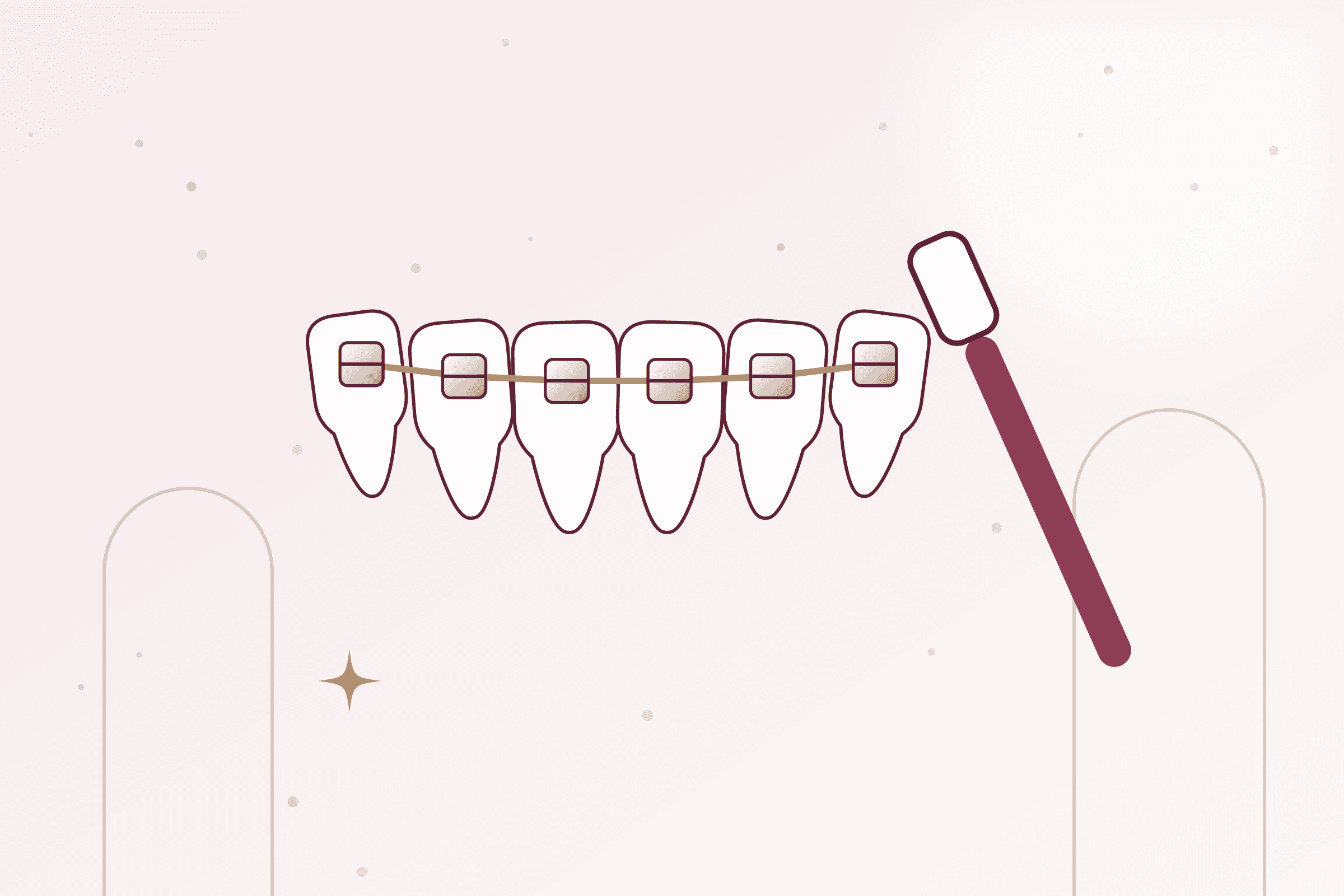
White spots after braces: how to prevent them
Why white spots form around brackets, how common they are, the role of fluoride and daily rules to prevent them.

AuthorDr. Fidan AliyevaOrthodontist, Pitts Masters graduate

Short answer: white spots are a sign that acid from plaque collected around the brackets has softened the enamel, in other words early decay. According to a meta-analysis, a considerable share of patients treated with braces develop new white spots during treatment. The good news is that they can be prevented: correct brushing, fluoride, limiting sugar and regular supervision greatly reduce the risk.
When the braces come off, the teeth are straight, but where the brackets were there are white, dull outlines. This is a result neither the patient nor the doctor wants. In this article I explain why white spots form and how to protect yourself from them.
Why they form
Brackets, wires and elastics create many new areas where plaque can collect. Bacteria in plaque turn sugar into acid, and the acid draws minerals out of the enamel. In these places the enamel starts to look dull and white. If the process continues, the spot can turn into a full cavity.
How common they are
In research the rate of white spots during treatment with braces has been high. In one study new white spots were recorded in more than a third of patients in the first months of treatment, and this figure rose as treatment continued. A meta-analysis also confirms that white spots are a very common problem in treatment with braces. These figures are not meant to scare you, but to show how important hygiene is.
Who is at higher risk
- Those who brush less than twice a day or in a hurry
- When sugary drinks and snacks are taken often
- Patients who had decay before treatment
- Teenagers, when supervision of hygiene decreases
- When treatment lasts a long time
How to prevent them
| Method | How | Note |
|---|---|---|
| Brushing | At least twice a day, above and below the brackets | The most important step |
| Fluoride toothpaste | Every time you brush | In some cases I recommend a high-fluoride toothpaste |
| Cleaning aids | Interdental brush, orthodontic floss | For areas under the brackets |
| Fluoride varnish | In the clinic at set intervals | In patients at risk |
| Diet | Reduce sugary drinks and snacks | Especially between meals |
| Supervision | Checking hygiene at every visit | Spotting an early lesion in time |
I explain the daily rules in detail here: daily braces care guide. About the benefit of an electric toothbrush: is an electric toothbrush better with braces.
Details in bonding
Preventing white spots is the doctor’s job too. Even small adhesive residues left around a bracket during bonding can hold plaque and make hygiene harder. That is why I carefully clean around every bracket. At every visit I check hygiene, and at the first signs of a spot we step up prevention.
If a spot has already formed
After the braces are removed, mild white spots may partly improve over time thanks to saliva and fluoride. For more noticeable spots a general dentist can offer methods that restore the enamel surface. Deep spots may not disappear completely. That is why the best approach is prevention.
A sample daily routine
- Morning: brush for 2-3 minutes after breakfast, above and below the brackets separately
- During the day: rinse with water after meals, brush briefly if possible
- Snacks: not sweets, but cheese, vegetables, pieces of fruit
- Evening: brushing, an interdental brush and orthodontic floss
- Before bed: after brushing with fluoride toothpaste, do not rinse too much so that the fluoride stays on the teeth
Spitting out the toothpaste is enough; rinsing with lots of water can reduce the effect of fluoride. This small habit makes a difference over a long treatment.
White spot risk with aligners
Because aligners are removable, brushing is easier. But since aligners cover the teeth, a sugary drink trapped under an aligner can act on the enamel for a long time. So the rule is the same with aligners: take them out before sweet and acidic drinks, then brush your teeth and put the aligners back.
What the science says
- Study (2011): during treatment with braces, new white spots appear in a considerable share of patients in the first months and increase as treatment continues.
- Meta-analysis (2015): the incidence and prevalence of white spots during treatment with braces are high.
- Cochrane review (2019): there is evidence of benefit from fluoride varnish and high-fluoride products for preventing early decay during brace treatment, but its certainty is low.
A beautiful result is not only straight teeth. Healthy enamel is part of that result too.
Frequently asked questions
Can white spots be removed by whitening?
Whitening can sometimes change how the spots look, but it does not remove them completely. We decide together with a general dentist.
Is the white spot risk lower with aligners?
Aligners come out, so brushing is easier. But wearing aligners while drinking sugary drinks increases the risk of spots.
Do I need a mouthwash?
A fluoride mouthwash may be recommended to some patients as an extra aid, but it does not replace brushing.
Where does a white spot first appear?
Most often on the side of the bracket nearest the gum. When you dry your teeth and look in a mirror, it shows as a dull white area.
Are braces to blame for white spots?
Braces create conditions for plaque to collect, but the main cause of a spot is the acid from bacteria in plaque. With good hygiene the risk drops considerably.
Related service
Scientific sources
The information in this article is based on the following peer-reviewed scientific articles and systematic reviews.
- Sundararaj, D., Venkatachalapathy, S., Tandon, A., & Pereira, A. (2015). Critical evaluation of incidence and prevalence of white spot lesions during fixed orthodontic appliance treatment: A meta-analysis. Journal of International Society of Preventive & Community Dentistry, 5(6), 433-439. [PMID: 26759794] | [DOI: 10.4103/2231-0762.167719]
- Tufekci, E., Dixon, J. S., Gunsolley, J. C., & Lindauer, S. J. (2011). Prevalence of white spot lesions during orthodontic treatment with fixed appliances. The Angle Orthodontist, 81(2), 206-210. [PMID: 21208070] | [DOI: 10.2319/051710-262.1]
- Benson, P. E., Parkin, N., Dyer, F., Millett, D. T., & Germain, P. (2019). Fluorides for preventing early tooth decay (demineralised lesions) during fixed brace treatment. Cochrane Database of Systematic Reviews, 2019(11), CD003809. [PMID: 31742669] | [DOI: 10.1002/14651858.CD003809.pub4]