Daily braces care guide
Braces change your smile, not your whole life. In this guide I explain brushing with braces, cleaning aids, food, elastics and urgent situations in plain words. At the end there is also a short quiz to see whether your child may need an orthodontist.

AuthorDr. Fidan AliyevaOrthodontist, Pitts Masters graduate
Careful brushing
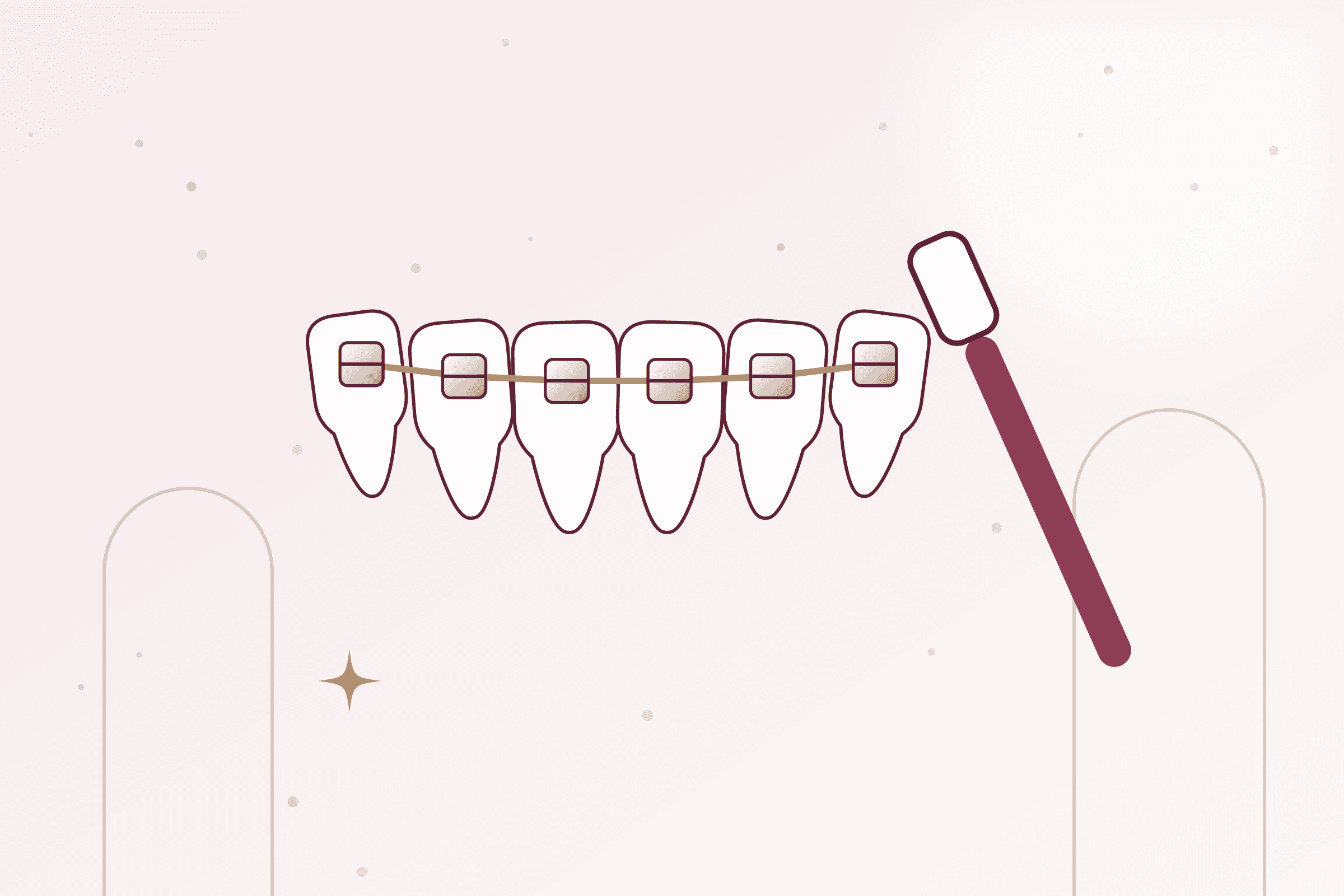
Food debris and plaque build up quickly around braces. If they are not cleaned in time, white spots can form on the enamel. That is why brushing matters even more with braces.
- At least twice a day, after every meal if possible
- With fluoride toothpaste
- Above and below every bracket, down to the gum line
- Replace the brush every 2-3 months or when the bristles splay
Cleaning aids
An ordinary brush does not fully reach under the wire and between the teeth. Small aids help clean these areas.
- A small interdental brush for under the wire
- Special floss or a floss threader for braces
- A water flosser if needed
- Use a mouthwash if your doctor recommends it
Food
There are fewer restrictions than you might think. The main rule: braces do not like very hard and sticky foods. Sometimes it is not what you eat but how you eat it.
- Slice apples and other hard fruit
- Cut meat into small pieces
- Avoid caramel, chewing gum and sticky sweets
- Do not bite nuts or ice
Elastics and homework
Treatment continues outside the clinic too. Wearing elastics as prescribed directly changes the result and the duration.
- Wear elastics during the prescribed hours
- Replace them with new ones at the prescribed interval
- Keep spare elastics with you
- If you need to remove them to eat, always put them back afterwards
Unexpected situations
A bracket coming off or a wire poking is rare and usually not urgent. But it should be reported without delay.
- Do not throw away a loose bracket, bring it to your visit
- Cover the end of a poking wire with orthodontic wax
- Pain and sensitivity in the first days are normal
- If there is a problem, message me on WhatsApp and attach a photo
Does your child need an orthodontist?
This short quiz looks at signs in tooth alignment, the bite and habits and gives a rough idea of how soon an orthodontic check is needed. Look at your child’s teeth in front of a mirror, answer 10 questions and see the result straight away.
Your answers are calculated only on your device: they are not sent to any server and are not stored.
Question 1 of 10
Low need
No serious signs for now.
Continue regular check-ups. If your child is over 6 and has never seen an orthodontist, one visit is enough: sometimes there are signs that are not visible at first glance.
Moderate need
Some signs make an orthodontic check advisable.
Come for an orthodontic check in the coming months. Sometimes treatment is needed, sometimes monitoring growth at intervals is enough. The key is to make the right decision at the right time.
High need
Do not delay the orthodontic check.
Several signs may need early intervention. For example, front teeth that stick out far are injured more easily, and a jaw that shifts to the side can affect growth. Come for a check without delay.
Need scale
- Low
- Moderate
- High
Whatever the quiz shows, I recommend planning the first orthodontic check from age 6. Following jaw growth and the change of teeth at this age helps start treatment at the right time.
Source on early treatment: Batista, K. B., Thiruvenkatachari, B., Harrison, J. E., & O’Brien, K. D. (2018). Orthodontic treatment for prominent upper front teeth (Class II malocclusion) in children and adolescents. Cochrane Database of Systematic Reviews, 3(3), CD003452. [PMID: 29534303] | [DOI: 10.1002/14651858.CD003452.pub4]
This quiz does not make a diagnosis and does not replace an examination. If there is pain, an injury or another change that worries you, see an orthodontist regardless of the result.
Four simple numbers
The success of treatment with braces does not depend on the doctor alone. These four habits help protect the result.
- a day brushing with fluoride toothpaste
- 2+ times
- usual interval between visits
- 1-2 months
- wearing elastics during the prescribed hours
- Every day
- wearing a retainer after treatment
- Long term
Why white spots appear
Plaque that stays around the brackets for a long time draws minerals out of the enamel and white spots form. Regular brushing and fluoride help prevent this. For patients at higher risk I may prescribe additional fluoride products.
Simple daily care
A few simple steps are often enough. The most important thing is to repeat them every day.
Morning and during the day
- Brush after breakfast
- Rinse your mouth with water after meals
- Put the elastics back with clean hands
- Keep a small brush and wax with you
Evening
- Brush carefully around every bracket
- Clean with an interdental brush or floss
- No food or sugary drinks after brushing
- Put on elastics or the retainer before sleep
Frequently asked questions
How many times a day should I brush with braces?
At least twice, in the morning and before bed, for 2-3 minutes each time. If possible, also rinse or brush briefly after meals.
Which foods should I avoid with braces?
Hard foods (nuts, ice, hard sweets), sticky foods (caramel, chewing gum) and hard fruit bitten whole. Cut apples and carrots into small pieces.
What should I do if a bracket comes off?
No need to panic. If the bracket is still on the wire, cover it with wax; if it fell off, keep it and message me so we can plan a visit.
How long should elastics be worn?
As prescribed, usually all day except while eating and brushing. Put on new elastics every day because old ones lose their force.
Does the bite check quiz make a diagnosis?
No. The quiz shows parents what to pay attention to, but a diagnosis can only be made at an orthodontic examination.
Scientific sources
The information in this article is based on the following peer-reviewed scientific articles and systematic reviews.
- Tufekci, E., Dixon, J. S., Gunsolley, J. C., & Lindauer, S. J. (2011). Prevalence of white spot lesions during orthodontic treatment with fixed appliances. The Angle Orthodontist, 81(2), 206-210. [PMID: 21208070] | [DOI: 10.2319/051710-262.1]
- Benson, P. E., Parkin, N., Dyer, F., Millett, D. T., & Germain, P. (2019). Fluorides for preventing early tooth decay (demineralised lesions) during fixed brace treatment. Cochrane Database of Systematic Reviews, 2019(11), CD003809. [PMID: 31742669] | [DOI: 10.1002/14651858.CD003809.pub4]
- Martin, C., Littlewood, S. J., Millett, D. T., Doubleday, B., Bearn, D., Worthington, H. V., & Limones, A. (2023). Retention procedures for stabilising tooth position after treatment with orthodontic braces. Cochrane Database of Systematic Reviews, 5(5), CD002283. [PMID: 37219527] | [DOI: 10.1002/14651858.CD002283.pub5]
- Batista, K. B., Thiruvenkatachari, B., Harrison, J. E., & O’Brien, K. D. (2018). Orthodontic treatment for prominent upper front teeth (Class II malocclusion) in children and adolescents. Cochrane Database of Systematic Reviews, 3(3), CD003452. [PMID: 29534303] | [DOI: 10.1002/14651858.CD003452.pub4]