Is an electric toothbrush better with braces?
Electric versus manual brushes with braces, the results of two meta-analyses, correct technique and what to watch with either brush.

AuthorDr. Fidan AliyevaOrthodontist, Pitts Masters graduate
Short answer: according to meta-analyses, an electric toothbrush has not been shown to have a clear advantage over a manual one in patients with braces. Good results are possible with either. What matters is technique, time and cleaning aids: the area above and below the bracket must be cleaned separately, and an interdental brush and orthodontic floss should be used. An electric brush can be convenient for some patients, especially children and those with low motivation.
After braces are fitted, patients’ first question is often: "Which brush should I buy?" In this article I explain what research says and how to brush correctly with braces whatever brush you use.
Why brushing with braces is harder
The bracket and wire divide the tooth surface into several parts. Plaque collects especially on the gum side of the bracket and under the wire. To clean these areas, the brush has to be held at different angles. Plaque that is not cleaned away can lead to white spots and gum inflammation. See: white spots after braces.
Comparison
| Electric brush | Manual brush | |
|---|---|---|
| Plaque removal | Good with correct technique | Good with correct technique |
| Convenience | The brush does the movement, has a timer | The hand does the movement |
| For children | Often more appealing | Parental supervision matters more |
| Travel | Needs a battery and heads | Simple |
| Head | An orthodontic head is available | A V-shaped orthodontic brush is available |
Correct technique
- Remove the elastics and rinse your mouth with water
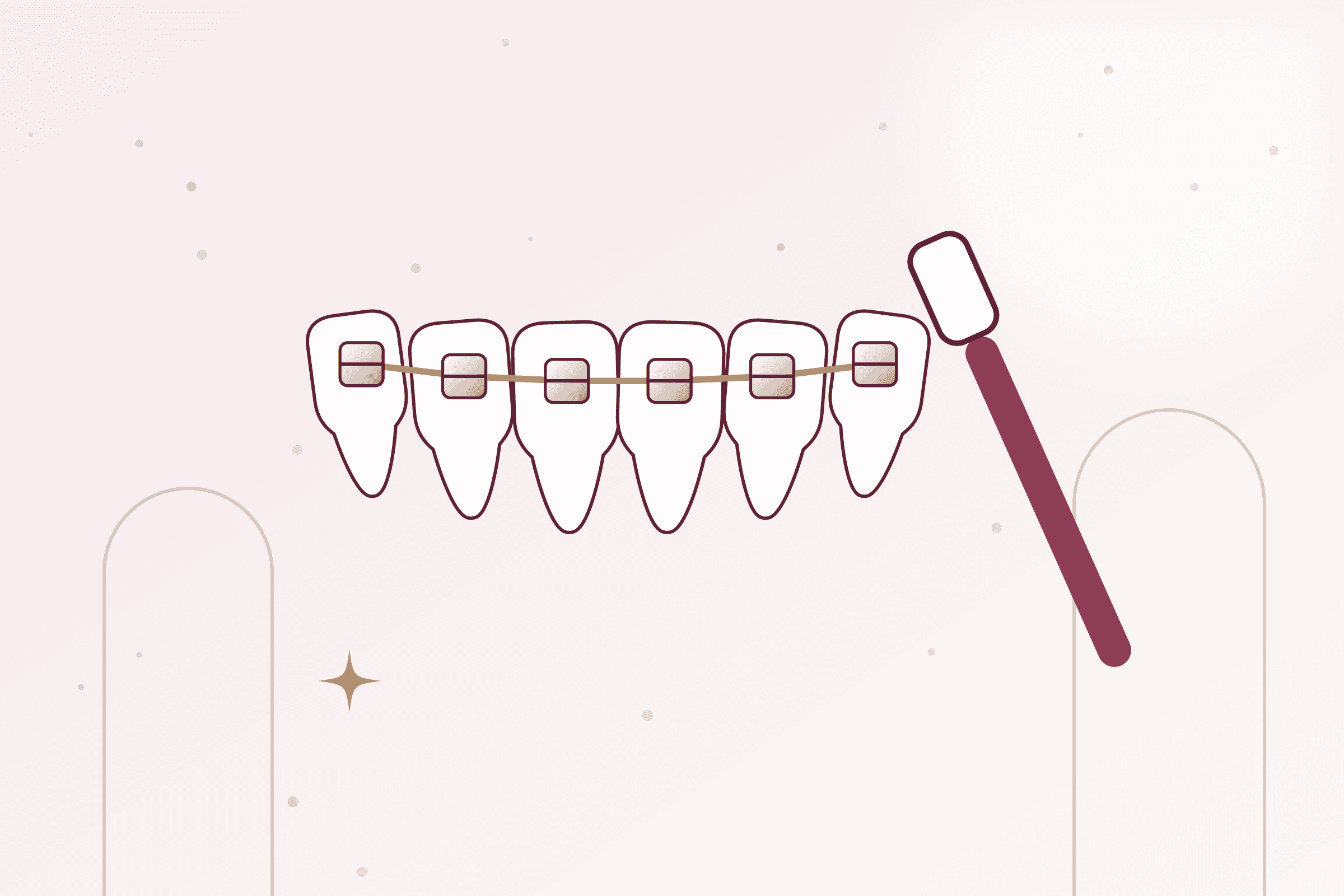
- Hold the brush at a 45 degree angle towards the gum and clean the top of the brackets
- Then hold the brush from below and clean the bottom of the brackets
- Do not forget the chewing surface and the inner side of every tooth
- Clean under the wire and between the brackets with an interdental brush
- Clean between the teeth with orthodontic floss
- At least 2-3 minutes in total, at least twice a day
With an electric brush, do not scrub along the teeth: hold it on each tooth for a few seconds and then move slowly to the next tooth. The brush moves by itself.
Cleaning aids
- Interdental brush: for under the wire and between the brackets
- Orthodontic floss or a floss threader
- A water flosser: can be an extra aid, it does not replace the brush
- Fluoride toothpaste, high-fluoride if needed
- A mirror and good light
The guide where I have gathered all the rules of daily care: daily braces care guide.
Who I recommend an electric brush to
- Children, to make brushing more appealing
- Those who find it hard to keep up brushing time
- Patients with limited hand movement
- Those whose hygiene does not improve with a manual brush
Myths and facts
| Belief | Fact |
|---|---|
| An electric brush is a must with braces | Research has not shown a clear advantage over a manual brush |
| Pressing hard cleans better | Pressing hard can damage the gums and knock off brackets |
| Mouthwash replaces the brush | Mouthwash is only an extra aid |
| Brushing once a day for a long time is enough | Brushing at least twice a day is recommended |
How to check your hygiene
After brushing, look in a mirror at the gum side of the brackets. The area around the bracket should be shiny and clean. If a dull, sticky layer remains, clean that area again. At every visit I check hygiene and show you the difficult areas.
Choosing a brush
Whichever brush you choose, the bristles should be soft or medium. Hard bristles can damage the gums. An electric brush may have a rotating round head or a sonic head: good results have been achieved with both in research; what matters is using them correctly. Models with a pressure sensor prevent pressing too hard and are useful for some patients. Among manual brushes, orthodontic brushes with a V-shaped cut in the middle help clean above and below the bracket at the same time.
The size of the interdental brush matters too: it should pass freely under the wire and between the teeth but should not be loose. We choose the size together at the first visit.
What the science says
- Meta-analysis (2008): in patients with braces an electric brush has not been shown to have an overall advantage over a manual brush in reducing plaque and gum inflammation.
- Systematic review and meta-analysis (2017): during orthodontic treatment the effect of an electric brush on gum health did not differ significantly from a manual brush in the short or long term.
The best brush is the one you use correctly every day.
Frequently asked questions
Can an electric brush knock off a bracket?
Not if used correctly. Do not press the brush hard against the bracket and use a gentle mode.
Is an orthodontic head needed?
Not necessarily, but it makes cleaning around the bracket easier for some patients. Technique is what matters.
Does a water flosser replace the brush?
No. It is an extra aid used together with a toothbrush and an interdental brush.
How often should the brush be changed?
With braces a brush wears out faster. Change it when the bristles splay, usually every 2-3 months, sometimes sooner.
Which brush is better for a child?
The brush the child is happy to use every day. For many children a timer electric brush is motivating, but a parent’s check matters either way.
How is floss used with braces?
With a floss threader or orthodontic floss with a stiff end, you pass the floss under the wire and clean between each pair of teeth. We practise this together the first time.
Related service
Scientific sources
The information in this article is based on the following peer-reviewed scientific articles and systematic reviews.
- Al Makhmari, S. A., Kaklamanos, E. G., & Athanasiou, A. E. (2017). Short-term and long-term effectiveness of powered toothbrushes in promoting periodontal health during orthodontic treatment: A systematic review and meta-analysis. American Journal of Orthodontics and Dentofacial Orthopedics, 152(6), 753-766.e7. [PMID: 29173855] | [DOI: 10.1016/j.ajodo.2017.09.003]
- Kaklamanos, E. G., & Kalfas, S. (2008). Meta-analysis on the effectiveness of powered toothbrushes for orthodontic patients. American Journal of Orthodontics and Dentofacial Orthopedics, 133(2), 187.e1-187.e14. [PMID: 18249278] | [DOI: 10.1016/j.ajodo.2007.07.015]