When a baby tooth is lost early: why the space matters
How space for the permanent tooth narrows after early loss of a baby tooth, when a space maintainer is needed and what a meta-analysis of split-mouth studies says.

AuthorDr. Fidan AliyevaOrthodontist, Pitts Masters graduate
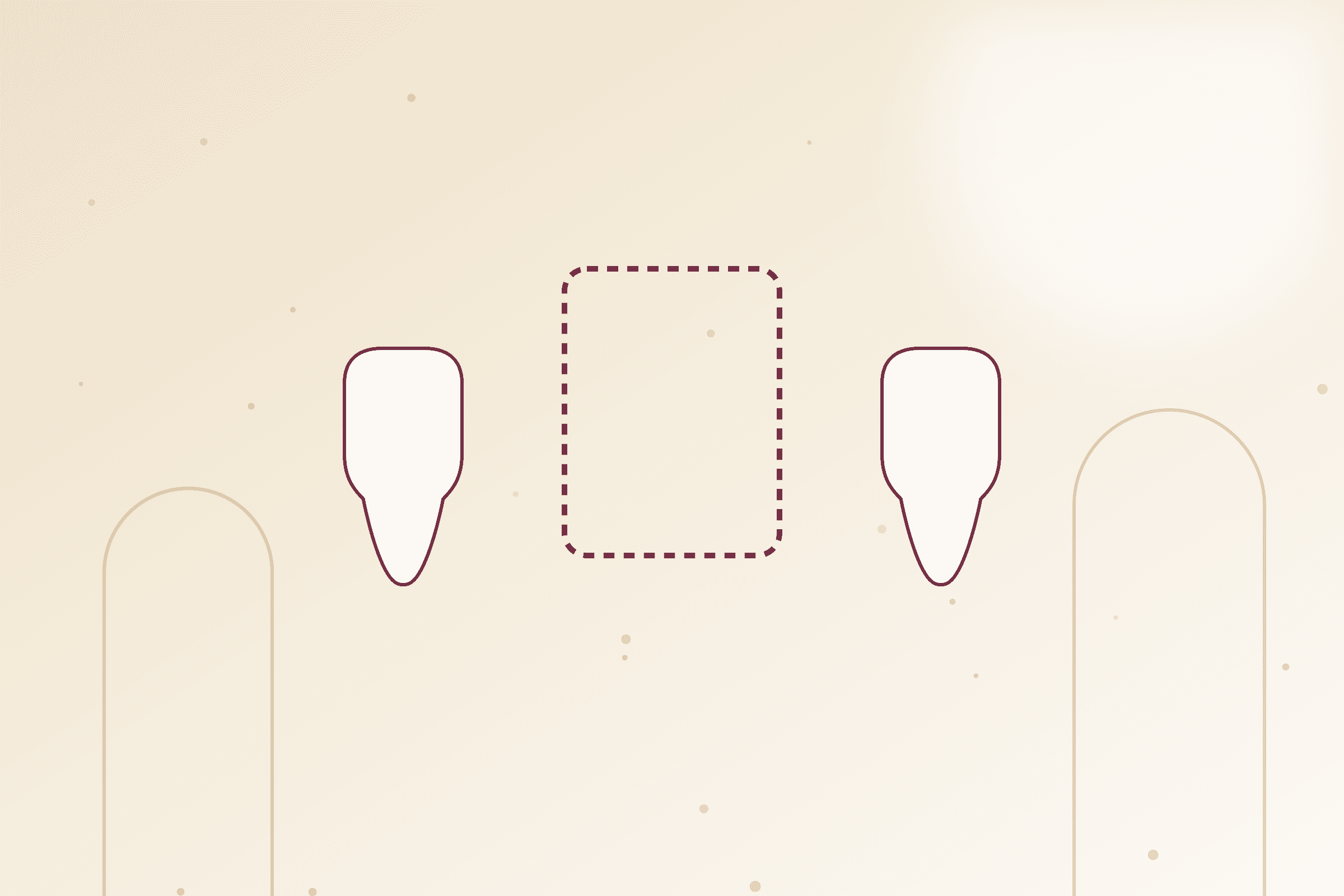
Short answer: a baby tooth is needed not only for chewing but also to keep the space for the permanent tooth growing beneath it. When a baby tooth is extracted or falls out early, the neighbouring teeth can drift into the gap and the space for the permanent tooth narrows. In such cases the orthodontist may recommend a space maintainer. The decision depends on which tooth was lost, at what age and when the permanent tooth will come in.
Parents often think: "It is only a baby tooth, it will change anyway." This is understandable, but baby teeth protect the path and space for the permanent teeth. In this article I explain the consequences of early loss of a baby tooth and when intervention is needed.
Why baby teeth are lost early
- Extraction because of deep decay
- A knock or injury
- Inflammation or an abscess
- Rarely, developmental features
What happens in the gap
Teeth in the mouth support one another. When a tooth is lost, the neighbouring teeth can tip or slide into the gap. The permanent molars behind are especially prone to drifting forward into the space. As a result the space for the permanent tooth growing beneath shrinks, and it either comes in crooked or cannot erupt and stays in the bone.
| Lost tooth | Possible effect | What we usually do |
|---|---|---|
| Baby front tooth | Space loss is usually small | Often monitor |
| First baby molar | Space may be lost, individual differences exist | Decide by age and bite |
| Second baby molar | The permanent molar may move forward, space loss can be larger | Often a space maintainer |
What a space maintainer is
A space maintainer is a simple appliance that keeps the distance between the teeth on either side of the gap. It can be fixed or removable. When the permanent tooth starts to erupt, the appliance is removed. It is small and children usually get used to it quickly.
Is it always needed
No. If the permanent tooth will come in soon or there is enough space, monitoring may be enough. To decide, I look at:
- Which tooth was lost and when
- How far the permanent tooth beneath has developed and when it will erupt, with an X-ray if needed
- Whether there is already crowding in the dental arch
- The overall state of the bite
If the space has already narrowed
In this case appliances that move teeth back or a short phase of braces may be needed to regain the lost space. In one young patient of ours, early loss and drifting of baby teeth could have led to more difficult problems later. So we started braces right after widening the upper jaw. More: palatal expansion.
The best approach: protect the baby tooth
- Brush your child’s teeth twice a day with fluoride toothpaste
- Limit sugary drinks and snacks
- Regular check-ups with a paediatric dentist
- If a baby tooth has been extracted, do not delay an orthodontic check
Myths and facts
| Belief | Fact |
|---|---|
| A baby tooth will change anyway, no treatment is needed | A baby tooth protects the space and path of the permanent tooth, and a decayed baby tooth needs treatment too |
| The gap keeps itself | Neighbouring teeth can drift into the gap |
| Every child needs a space maintainer | The decision depends on which tooth was lost and at what age |
| The permanent tooth will find its place wherever it is | When space narrows, the permanent tooth may come in crooked or stay in the bone |
Daily life with a space maintainer
- Avoid sticky and very hard foods
- Brush carefully around the appliance every day
- Wear a removable appliance as instructed
- If the appliance loosens or breaks, message me without delay
- Come to check-ups
What the science says
- Systematic review and meta-analysis (2023): after early loss of first baby molars, spatial changes occur in the dental arch. The amount of change varies and should be assessed individually in each child.
This review is based on split-mouth studies: one side of the same child has lost a tooth and the other side is used for comparison. This makes the results more reliable, but each child’s decision is still made individually.
A baby tooth is temporary, but the space it protects is the future of the permanent tooth.
If your child has lost a baby tooth early, book a visit. More: when should a child first see an orthodontist and orthodontics for children.
Frequently asked questions
How soon after a baby tooth is extracted should we come?
As soon as possible, ideally within a few weeks. Space can be lost faster in the months after the extraction.
Is a space maintainer painful?
No. Fitting it is simple; only getting used to it takes a few days.
A baby front tooth fell out. Should I worry?
Space loss is usually small with front teeth. But since it can affect speech and appearance, it is useful to have it assessed.
How long does a space maintainer stay?
Until the permanent tooth starts to erupt. We follow this with X-rays and check-ups.
Does a decayed baby tooth need treatment?
Yes. A decayed baby tooth can cause pain, inflammation and early loss. Treatment by a paediatric dentist also protects the space for the permanent tooth.
Related service
Scientific sources
The information in this article is based on the following peer-reviewed scientific articles and systematic reviews.
- Zhao, J., Jin, H., Li, X., & Qin, X. (2023). Dental arch spatial changes after premature loss of first primary molars: a systematic review and meta-analysis of split-mouth studies. BMC Oral Health, 23(1), 430. [PMID: 37380944] | [DOI: 10.1186/s12903-023-03111-x]