Braces or aligners: which to choose?
Strengths and weaknesses of both methods, what comparative research shows, when I recommend which and the role of daily life in the choice.

AuthorDr. Fidan AliyevaOrthodontist, Pitts Masters graduate
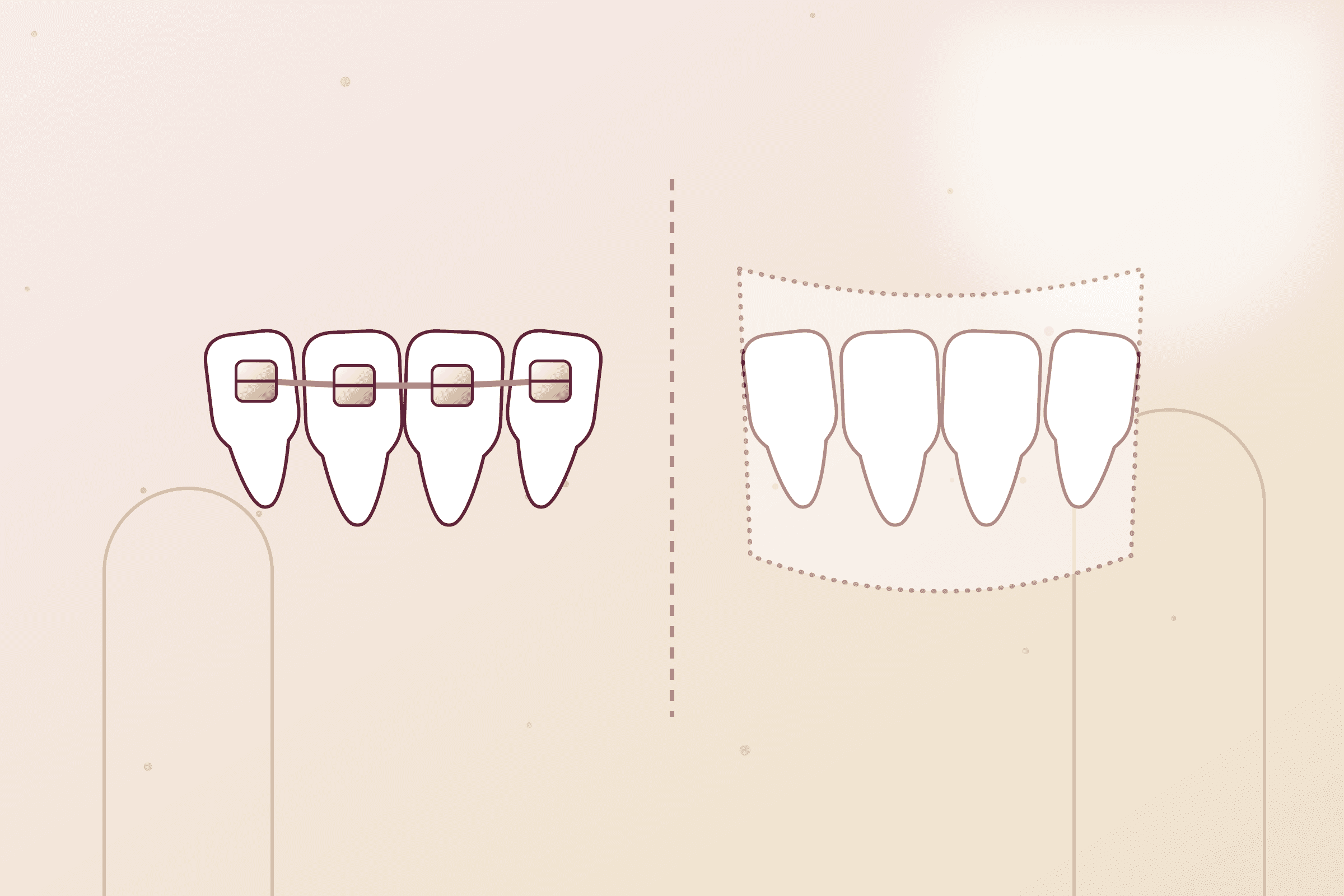
Short answer: both braces and aligners are effective treatment methods. According to research, braces are more precise at controlling the bite relationship and root position, while aligners are invisible, removable and convenient for hygiene. The choice depends on which movements your teeth need and on your daily life. Sometimes the best answer is a combination of both.
One of the most common questions at a consultation is: "I don’t want braces, can I have aligners?" This question is completely normal. In this article I compare the two methods openly so that you can make an informed decision.
How the two methods work
Braces are bonded to the teeth and the wire running through them applies a continuous force. The orthodontist controls the movement at each visit by changing the wire or elastics. Aligners are clear trays planned on a computer: each new aligner moves the teeth a small distance. Here movement happens through a sequence of aligners made in advance, and the orthodontist checks that it follows the plan.
Side by side
| Criterion | Braces | Aligners |
|---|---|---|
| Appearance | Visible, ceramic brackets less so | Almost invisible |
| Control | Precise for all movements | Limited for some movements |
| Hygiene | Needs more attention | Aligners come out, brushing is easy |
| Food | Limits on hard and sticky foods | Removed for eating |
| Discipline | Always in the mouth | Must be worn the recommended hours a day |
| Visits | Adjustment every 1-2 months | Check-ups, sometimes less frequent |
| Breakage | A bracket may come off, a wire may poke | An aligner may be lost or crack |
How daily life changes
| Situation | With braces | With aligners |
|---|---|---|
| Eating out | Avoid hard and sticky foods | Remove the aligners and clean your teeth afterwards |
| Coffee and tea | Fine to drink, rinse afterwards | Better to remove the aligners, always remove them for sugary drinks |
| Meetings and talks | Ceramic brackets are less visible | Almost invisible, speech may change slightly in the first days |
| Sport | A mouthguard for contact sports | Remove the aligners and wear a mouthguard |
| Travel | Wax and cleaning aids | Next aligners and a case |
Questions to help you decide
- Which movements does my bite problem require?
- Will I be able to wear aligners for the recommended hours a day?
- How important is appearance to me?
- How often can I come to visits?
- How much time can I give to hygiene?
We discuss the answers to these questions together at the consultation, then I suggest the method that suits you. Sometimes the answer is unexpected: a ceramic brace may suit a patient who values aesthetics, and aligners may suit a disciplined patient even in a complex case.
What the science says
- Systematic review (2015): aligners are effective for alignment and some movements, while lengthening teeth and rotating round teeth are harder to control.
- Comparative review (2019): both methods are effective. Braces did better on measures such as the bite relationship, tooth angulation and root control, while in some simple cases aligner treatment was shorter.
- Systematic review (2016): treatment with braces takes about 20 months on average.
When I recommend braces
- A significant bite correction is needed: deep, open or reverse bite
- Root position must be controlled precisely, for example when closing spaces after extractions
- There are very rotated round teeth
- The height of the front teeth and the smile arc must be finely controlled
- You know it will be hard to wear aligners for the required hours
When aligners are a good choice
- Mild to moderate crowding or spacing
- Minor relapse after previous treatment
- Invisible treatment matters for your social and working life
- Hygiene needs to be easier because of gum problems
- You are ready to wear the aligners with discipline
A combined approach
Sometimes we start treatment with one method and finish with the other. For example, the difficult movements can be done with braces for a short time and the final stage completed with aligners. In aligner treatment, elastics and mini-screws can be used as additional anchorage.
The plan, not the method, determines the result
Two patients can be treated with the same method and get different results if their plans differ. So the first question is not "braces or aligners" but "how should the teeth, the bite and the smile look at the end". We choose the method after answering it. I wrote separately about the risks of using aligners without orthodontic supervision: can you order aligners online.
The tool matters, but the result is created by the plan and the doctor’s supervision.
To find out which method suits you, see the braces treatment and aligners pages or book a consultation.
Frequently asked questions
Are aligners less painful than braces?
With both methods there is a feeling of pressure in the first days. With aligners this usually happens in the first 1-2 days of each new aligner, with braces after an adjustment.
Can I start with braces and switch to aligners?
Yes, in some cases this is a sensible plan. We decide when to switch based on how treatment progresses.
Are ceramic braces visible?
Ceramic brackets are tooth-coloured and much less visible than metal ones, but they are not completely invisible.
Which do you recommend for teenagers?
It depends on the bite and the teenager’s discipline. For growth-related problems braces or special appliances often give better results.
Related service
Scientific sources
The information in this article is based on the following peer-reviewed scientific articles and systematic reviews.
- Rossini, G., Parrini, S., Castroflorio, T., Deregibus, A., & Debernardi, C. L. (2015). Efficacy of clear aligners in controlling orthodontic tooth movement: a systematic review. The Angle Orthodontist, 85(5), 881-889. [PMID: 25412265] | [DOI: 10.2319/061614-436.1]
- Ke, Y., Zhu, Y., & Zhu, M. (2019). A comparison of treatment effectiveness between clear aligner and fixed appliance therapies. BMC Oral Health, 19(1), 24. [PMID: 30674307] | [DOI: 10.1186/s12903-018-0695-z]
- Tsichlaki, A., Chin, S. Y., Pandis, N., & Fleming, P. S. (2016). How long does treatment with fixed orthodontic appliances last? A systematic review. American Journal of Orthodontics and Dentofacial Orthopedics, 149(3), 308-318. [PMID: 26926017] | [DOI: 10.1016/j.ajodo.2015.09.020]